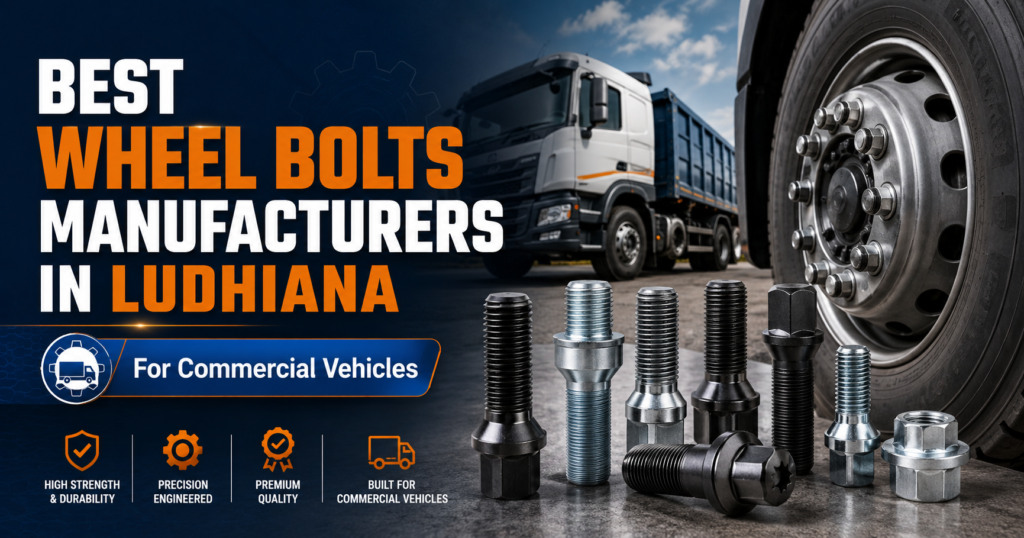
Wheel bolts are essential safety components used to secure the wheels of trucks, trailers, buses and other commercial vehicles to the wheel hub. They operate under constant load, vibration, braking pressure and changing road conditions. Because of this demanding role, wheel bolts must provide accurate threading, high tensile strength, reliable heat treatment and consistent dimensional quality.
Businesses searching for the best wheel bolts manufacturers in Ludhiana for commercial vehicles should consider much more than product price. The quality of the steel, manufacturing process, strength grade, thread accuracy and testing standards all influence the performance and service life of a wheel bolt.
This article explains what makes a reliable wheel bolt manufacturer and how buyers can choose suitable products for heavy-duty vehicle applications.
What Are Wheel Bolts?
Wheel bolts are threaded automotive fasteners that connect the wheel directly to the vehicle hub. They pass through the wheel mounting holes and screw into matching threaded holes in the hub assembly.
Depending on the vehicle design, wheels may be secured using:
- Wheel bolts
- Wheel studs
- Wheel nuts
- Hub bolts
- Complete wheel-fastening assemblies
Although these components serve a similar purpose, their designs and installation methods differ. Buyers must select the exact fastening system specified for the vehicle.
Wheel bolts are commonly used in:
- Heavy commercial trucks
- Trailers
- Buses
- Light commercial vehicles
- Agricultural tractors
- Construction equipment
- Mining vehicles
- Material-handling equipment
- Industrial transport vehicles
Why Wheel Bolt Quality Matters
Wheel bolts create the clamping force that keeps the wheel firmly seated against the hub. If the bolt is weak, incorrectly sized or improperly tightened, the wheel may move during operation.
High-quality wheel bolts help:
- Maintain secure wheel mounting
- Distribute clamping force evenly
- Prevent movement between the wheel and hub
- Support stable braking and steering
- Reduce vibration-related loosening
- Protect wheel mounting holes
- Improve commercial vehicle safety
- Reduce unexpected maintenance
A failed wheel bolt can damage the wheel, hub, brake components and nearby fasteners. In severe cases, it may contribute to wheel separation.
Why Ludhiana Is Known for Wheel Bolt Manufacturing
Ludhiana is one of India’s major manufacturing centres for automotive fasteners, commercial vehicle components, agricultural machinery parts and engineering products.
The city has access to:
- Steel suppliers
- Forging facilities
- Thread-rolling units
- CNC machining
- Heat-treatment plants
- Surface-coating facilities
- Skilled automotive component manufacturers
- Domestic and export logistics networks
Experienced wheel bolts manufacturers in Ludhiana supply products to vehicle manufacturers, spare-parts dealers, fleet operators, workshops, distributors and international buyers.
The established industrial ecosystem also supports standard and customised production for different commercial vehicle applications.
Types of Wheel Bolts for Commercial Vehicles
Wheel bolts are available in different designs depending on the wheel, hub and vehicle specifications.
Standard Wheel Bolts
Standard wheel bolts are manufactured in commonly used diameters, lengths and thread pitches for regular automotive applications.
They are suitable when the vehicle uses an established and widely available wheel-fastening specification.
Flange Wheel Bolts
Flange wheel bolts have a wider bearing surface under the head. The flange distributes tightening pressure over a larger area.
This design may be used in commercial vehicles where broader contact and stable clamping are required.
Conical Seat Wheel Bolts
Conical seat bolts have a tapered seating surface. The tapered profile fits into a matching wheel hole and helps centre the wheel during installation.
The cone angle must match the wheel specification exactly.
Ball Seat Wheel Bolts
Ball seat wheel bolts have a curved or radius-shaped seating surface. They are used with wheels designed for rounded bolt seats.
A ball seat bolt should never be replaced with a conical seat bolt unless the wheel manufacturer approves the change.
Flat Seat Wheel Bolts
Flat seat wheel bolts use a flat bearing surface, sometimes combined with a washer.
These bolts are used in applications where the wheel mounting hole requires a flat contact profile.
Custom Wheel Bolts
Custom wheel bolts may be manufactured for:
- Imported commercial vehicles
- Vintage trucks
- Modified wheels
- Special-purpose trailers
- Construction equipment
- Agricultural machinery
- Non-standard hubs
- Heavy-duty industrial vehicles
Custom production can include specific head shapes, thread sizes, lengths, coatings and strength requirements.
Important Wheel Bolt Measurements
The correct wheel bolt must match the wheel and hub precisely. Buyers should confirm all important measurements before ordering.
Bolt Diameter
The bolt diameter must match the threaded hub hole. A bolt that is too large will not fit, while an undersized bolt may not engage the threads securely.
The diameter should be measured using a vernier caliper, micrometre or bolt gauge.
Thread Pitch
Thread pitch is the distance between adjacent threads.
An incorrect thread pitch may appear to start correctly but can damage the hub threads when tightened. Buyers should never force a bolt into the hub.
Overall Length
Overall bolt length includes the head and threaded body, depending on the manufacturer’s measuring standard.
The selected bolt must provide adequate engagement without extending too far into the hub assembly.
Threaded Length
The threaded portion must provide sufficient contact with the hub threads.
Insufficient engagement can reduce clamping strength, while excessive length may interfere with brake or hub components.
Head Size
The bolt head must match the installation tool and provide enough strength for the recommended tightening torque.
A damaged or incorrectly shaped head can cause tool slippage during installation or removal.
Seat Profile
The wheel bolt seat may be conical, ball-shaped or flat. The seat must match the wheel mounting hole.
Using the wrong seat profile can result in uneven contact, poor wheel centring and loss of clamping force.
Material Used in Wheel Bolt Manufacturing
Commercial vehicle wheel bolts require steel with suitable strength, toughness and fatigue resistance.
Common materials may include:
- Medium-carbon steel
- High-carbon steel
- Alloy steel
- Automotive-grade steel
- Customer-specified material grades
The material selection depends on:
- Vehicle weight
- Wheel design
- Axle load
- Required torque
- Operating environment
- Strength class
- Manufacturer specification
Heavy trucks and trailers generally require stronger wheel bolts than light-duty vehicles.
Buyers should ask the supplier about the material grade rather than judging the product only by its finish or appearance.
Importance of Strength Grade
The strength grade indicates the mechanical performance of a fastener.
A suitable wheel bolt should resist:
- Stretching
- Bending
- Thread stripping
- Fatigue cracking
- Head deformation
- Sudden breakage
The required grade must match the commercial vehicle manufacturer’s specification.
Using a lower-grade bolt may result in premature failure. At the same time, an excessively hard bolt may become brittle if the material and heat treatment are not properly controlled.
Role of Heat Treatment
Heat treatment improves the strength and durability of wheel bolts.
The process may involve:
- Hardening
- Quenching
- Tempering
- Stress relieving
- Hardness testing
Correct heat treatment helps achieve a balance between tensile strength and toughness.
Poor heat treatment can lead to:
- Uneven hardness
- Brittle bolts
- Bolt stretching
- Premature thread failure
- Cracks near the head
- Inconsistent performance within a batch
Reliable manufacturers should control heat-treatment temperature, timing and cooling conditions.
Thread Rolling Versus Thread Cutting
Threads may be produced through thread rolling or thread cutting.
Thread Rolling
Thread rolling forms the thread by pressing the material between dies. It does not remove metal from the bolt.
Potential benefits include:
- Improved thread strength
- Smooth thread surfaces
- Better dimensional consistency
- Higher fatigue resistance
- Efficient bulk manufacturing
Thread Cutting
Thread cutting removes material to create the thread profile. It may be suitable for selected custom or low-volume components.
For many automotive applications, rolled threads are preferred because of their strength and consistency.
Surface Finishes for Wheel Bolts
Wheel bolts are exposed to water, road dirt, humidity, mud and temperature changes. Surface finishes help protect the steel from corrosion.
Common coating options include:
- Black finish
- Zinc plating
- Yellow zinc coating
- Phosphate coating
- Geomet-type coating
- Dacromet-type coating
- Oil coating
- Customer-specified protective finish
The appropriate coating depends on the operating environment and corrosion-resistance requirement.
Coatings also affect friction during tightening. Torque values should therefore follow the recommendations for the specific bolt finish.
Manufacturing Process of Wheel Bolts
A typical wheel bolt manufacturing process may include the following stages.
Raw Material Selection
Steel rods or wire of the required grade and diameter are selected.
Cutting
The material is cut into blanks according to the required bolt length.
Head Forming
The bolt head is produced through cold forging, hot forging or precision machining.
Seat Formation
The conical, ball or flat seating profile is formed according to the wheel specification.
Thread Production
Threads are rolled or cut to the required diameter and pitch.
Heat Treatment
The bolts undergo heat treatment to achieve the specified hardness and tensile strength.
Surface Coating
A protective surface finish is applied where required.
Inspection
Finished wheel bolts are checked for:
- Diameter
- Length
- Thread pitch
- Head dimensions
- Seat angle or radius
- Straightness
- Hardness
- Surface quality
- Coating consistency
Qualities of the Best Wheel Bolts Manufacturers
A reliable wheel bolt manufacturer should demonstrate strong technical and quality-control capabilities.
Consistent Raw Material
The manufacturer should use steel that matches the required automotive specification.
Material consistency is important because variations can affect heat treatment and bolt strength.
Accurate Dimensions
Each bolt should maintain consistent diameter, length, thread pitch, head size and seat profile.
Dimensional errors can create installation difficulties or unsafe wheel mounting.
Controlled Heat Treatment
The manufacturer should maintain controlled heat-treatment processes and perform hardness checks.
Clean Threading
Threads should be smooth, uniform and free from burrs, cracks or damage.
Application-Based Customisation
A capable manufacturer should develop custom products from drawings, samples or detailed measurements.
Batch-Level Inspection
Bulk orders should be checked at different stages to ensure consistent production quality.
Proper Packaging
Threads, heads and protective coatings should be protected during storage and transport.
Reliable Delivery
The supplier should maintain consistent production schedules for regular and repeat orders.
How to Choose Wheel Bolts Manufacturers in Ludhiana
Before selecting a supplier, buyers should evaluate several factors.
Check Automotive Manufacturing Experience
Experience with commercial vehicle fasteners is important because these products require greater precision and strength than ordinary hardware.
Ask About the Available Product Range
Confirm whether the manufacturer can supply:
- Different bolt diameters
- Multiple thread pitches
- Standard and custom lengths
- Conical seats
- Ball seats
- Flat seats
- Flange heads
- Custom head profiles
- Different surface coatings
Verify Material and Strength Information
Ask for details about:
- Steel grade
- Strength class
- Heat-treatment process
- Hardness range
- Testing standards
Review Custom Manufacturing Capability
A reliable supplier should be able to manufacture wheel bolts from an old sample, technical drawing or hub specification.
Evaluate Quality-Control Procedures
Buyers should ask whether the company inspects:
- Thread accuracy
- Dimensions
- Seat profile
- Head shape
- Hardness
- Surface finish
- Straightness
- Coating thickness
Confirm Production Capacity
Distributors, exporters and commercial vehicle manufacturers should confirm that the supplier can maintain quality across large volumes.
Assess Packaging and Labelling
Good packaging helps prevent thread damage and corrosion.
Buyers may also require:
- Private labelling
- Batch identification
- Product codes
- Export packaging
- Custom carton quantities
Correct Wheel Bolt Selection Checklist
Before ordering wheel bolts, confirm:
- Vehicle make and model
- Wheel type
- Hub design
- Bolt diameter
- Thread pitch
- Overall length
- Threaded length
- Head size
- Seat type
- Seat angle or radius
- Material grade
- Strength class
- Surface finish
- Required quantity
For old or modified commercial vehicles, providing a physical sample may help prevent errors.
Common Wheel Bolt Selection Mistakes
Choosing the wrong bolt can affect both installation and vehicle safety.
Selecting the Wrong Seat Type
Conical, ball and flat seats are not interchangeable.
The wrong seat may cause uneven contact and poor wheel alignment.
Using Incorrect Thread Pitch
A mismatched thread can damage the bolt and hub.
Choosing the Wrong Length
A short bolt may not engage enough threads. An excessively long bolt may interfere with internal hub components.
Ignoring Strength Grade
A correctly sized bolt can still fail if it does not have sufficient tensile strength.
Reusing Damaged Bolts
Wheel bolts with stretched, corroded or damaged threads should be replaced.
Mixing Different Bolt Types
Using different seat types, lengths or strength grades on the same wheel can create uneven clamping force.
Correct Wheel Bolt Installation
Even a high-quality wheel bolt can fail if it is installed incorrectly.
Good installation practices include:
- Cleaning the wheel and hub surfaces
- Inspecting the threaded holes
- Checking the bolt seat profile
- Starting each bolt by hand
- Tightening bolts in the recommended sequence
- Using a calibrated torque wrench
- Applying the specified torque
- Rechecking wheel torque where required
Bolts should not be tightened randomly because uneven clamping may distort the wheel or cause vibration.
Importance of Correct Torque
Torque creates the clamping force that holds the wheel against the hub.
Under-tightening may allow the wheel to move. Over-tightening may stretch the bolt, damage the hub threads or distort the wheel.
Commercial vehicle technicians should follow the vehicle manufacturer’s torque specification.
Impact tools may be used for initial installation, but final tightening should be performed with a calibrated torque wrench.
Common Reasons Wheel Bolts Fail
Wheel bolt failure may result from:
- Low-quality steel
- Incorrect heat treatment
- Wrong thread pitch
- Insufficient thread engagement
- Incorrect seat profile
- Excessive tightening torque
- Loose installation
- Damaged hub threads
- Corrosion
- Vehicle overloading
- Repeated impact-wrench use
- Reusing stretched bolts
- Damaged wheel mounting holes
When one wheel bolt fails, all bolts and related components on that wheel should be inspected.
Warning Signs of Wheel Bolt Problems
Commercial vehicle owners and technicians should watch for:
- Loose wheel bolts
- Repeated loss of torque
- Damaged bolt heads
- Rust around wheel holes
- Cracked or stretched threads
- Wheel vibration
- Clicking or knocking sounds
- Uneven wheel seating
- Enlarged mounting holes
- Difficulty tightening or removing bolts
These symptoms may indicate a problem with the bolt, wheel or hub assembly.
Wheel Bolts Versus Wheel Studs
Wheel bolts screw directly into the hub. Wheel studs remain fitted in the hub, and the wheel is secured using nuts.
Each system has its own advantages and vehicle-specific requirements.
Buyers should not convert from bolts to studs or studs to bolts without professional technical guidance.
The selected component must match:
- Hub design
- Wheel thickness
- Thread specification
- Seat profile
- Vehicle load
- Manufacturer recommendation
Custom Wheel Bolts for Heavy Vehicles
Custom wheel bolts may be required when standard parts do not match the vehicle.
Typical custom requirements include:
- Non-standard diameter
- Special thread pitch
- Extended length
- Reduced head profile
- Unique seat angle
- Special flange design
- High-strength alloy steel
- Enhanced corrosion coating
- Custom head marking
- Private-label packaging
A manufacturer may request a technical drawing or original sample before starting production.
Benefits of Buying Directly from a Manufacturer
Sourcing directly from established wheel bolts manufacturers in Ludhiana can provide several advantages:
- Competitive bulk pricing
- Standard and custom products
- Better material control
- Consistent dimensions
- Direct technical communication
- Faster repeat orders
- Private-label options
- Custom packaging
- Domestic and export supply
- Batch-level quality inspection
Direct sourcing is especially useful for commercial vehicle distributors, fleet operators, workshops, exporters and equipment manufacturers.
Questions to Ask a Wheel Bolt Supplier
Before placing a bulk order, buyers may ask:
- Which steel grade is used?
- What strength classes are available?
- Are the threads rolled or cut?
- Is heat treatment performed in-house?
- How is hardness tested?
- Which seat profiles are available?
- Can custom drawings be manufactured?
- What coating options are offered?
- What is the minimum order quantity?
- Is private labelling available?
- What quality checks are performed?
- How are products packed for transport?
Clear communication helps buyers compare suppliers based on technical capability rather than price alone.
Conclusion
Choosing the best wheel bolts for commercial vehicles requires careful evaluation of bolt diameter, thread pitch, length, seat profile, material grade, heat treatment, strength and surface finish. Every wheel bolt must match the vehicle hub and wheel specifications accurately to maintain secure clamping and safe road performance.
For dependable and precisely manufactured wheel bolts, businesses can choose Benz Auto Corporation, a trusted manufacturer of automotive fastening components for trucks, trailers, buses and heavy-duty vehicles. Buyers searching for the best wheel bolts manufacturers in Ludhiana for commercial vehicles can approach Benz Auto Corporation for standard and customised wheel bolts developed with a focus on dimensional accuracy, strength, durability and reliable performance.